Lifeguard On Site Training – Building Safer Communities
Lifeguard training is one of the most important steps a person can take toward becoming a responsible aquatic safety professional. A trained lifeguard is not only watching the water. A lifeguard is actively preventing emergencies, recognizing swimmers in distress, responding to injuries, performing rescues, providing CPR/AED and First Aid, and working as part of a coordinated safety team.
The American Lifeguard Association provides lifeguard training designed to help students prepare for the real responsibilities of lifeguarding at pools, waterparks, camps, schools, hotels, resorts, fitness centers, community aquatic facilities, and other supervised aquatic environments. Lifeguard training should be practical, serious, accessible, and focused on the goal that matters most: helping prevent drowning and water-related injuries.
Drowning remains a major public safety concern in the United States. The CDC reports that more children ages 1–4 die from drowning than any other cause of death, and drowning is the second-leading cause of unintentional injury death for children ages 5–14. The CDC also reports that the United States has more than 4,000 unintentional drowning deaths each year. (CDC)
Those numbers show why lifeguard training matters. A well-trained lifeguard can help identify risks before they become emergencies, respond quickly when someone is in distress, and support a safer aquatic environment for families, children, swimmers, guests, and employees.
Lifeguard training is a structured program that teaches the knowledge, judgment, rescue skills, emergency care skills, and professional responsibilities needed to help protect people in and around the water. A complete lifeguard training program generally includes water rescue, victim recognition, surveillance, CPR/AED, First Aid, emergency action plans, injury prevention, professional conduct, and preparation for employment in an aquatic setting.
The American Lifeguard Association’s training model includes lifeguarding, CPR/AED, First Aid, and injury-prevention topics designed to prepare students for aquatic emergencies. ALA’s public training materials describe lifeguard training as covering swimming and rescue skills, CPR/AED, First Aid, and injury prevention techniques. (American Lifeguard Association)
Lifeguard training should not be viewed as simply completing a course or passing an exam. It is the beginning of a professional safety role. Lifeguards are trusted with the responsibility of helping protect lives. That requires attention, preparation, maturity, and continuing practice.
A strong lifeguard training program helps students understand how to prevent emergencies, how to recognize danger, how to respond when seconds matter, and how to continue improving after certification.
Aquatic emergencies can happen quickly. A swimmer may become tired, a child may slip under the surface, a guest may suffer a medical emergency, or a rescue may require immediate action before emergency medical services arrive. Lifeguard training prepares students to respond in those critical moments.
The U.S. Department of Labor describes lifeguard duties as including rescuing swimmers, monitoring swimming activities to prevent accidents, assisting patrons, maintaining order, and administering First Aid. These responsibilities show why lifeguard training must include both prevention and emergency response. (DOL)
The best lifeguards are proactive. They do not wait for an emergency to become obvious. They scan carefully, identify unsafe behavior, communicate with guests, enforce rules, and stay ready to respond. Prevention is one of the most important parts of lifeguard training because preventing a drowning is always better than attempting a rescue after a victim is already in danger.
Professional lifeguard training helps students develop:
Water safety awareness.
Rescue readiness.
CPR/AED and First Aid confidence.
Emergency response discipline.
Communication skills.
Decision-making under pressure.
Professional responsibility.
Teamwork with other lifeguards and staff.
A trained lifeguard must be able to act quickly, but also correctly. Training helps build that judgment.
Global drowning deaths each year (WHО)
Cause of injury death, ages 1-4 in the U.S.
Years of ALA lifeguard training
Lifeguard training includes several core areas. Each one supports the overall goal of preparing lifeguards to help prevent, recognize, and respond to emergencies.
Water surveillance is one of the most important skills in lifeguarding. Lifeguards must continuously scan their assigned area, recognize unsafe behavior, identify swimmers who may be struggling, and respond before the situation becomes worse. Good surveillance requires focus. A lifeguard must avoid distractions, understand assigned zones, watch movement patterns, recognize high-risk swimmers, and communicate concerns to other members of the safety team. Lifeguard training teaches students that drowning may not look dramatic. A person in distress may not be able to shout, wave, or call for help. Effective scanning and early recognition are critical.
A trained lifeguard must be able to recognize different types of aquatic distress. This can include a tired swimmer, an active drowning victim, a passive drowning victim, a submerged victim, or a person experiencing a medical emergency in or near the water. Victim recognition is a skill that improves with training and practice. Students learn to watch for body position, facial expression, movement, lack of progress, sudden silence, unusual behavior, and other warning signs. The faster a lifeguard recognizes a problem, the faster help can begin.
Water rescue skills are a central part of lifeguard training. Students learn how to approach a victim, use rescue equipment, make contact safely, support the victim, remove the victim from the water, and provide care after the rescue. Water rescue training may include active victim rescues, passive victim rescues, submerged victim recovery, assists, entries, approaches, escapes, removals, and use of rescue tubes or other safety equipment. The goal is to rescue the victim while also protecting the lifeguard. A trained lifeguard understands that rescue technique, body position, equipment use, and calm control are just as important as swimming ability.
CPR and AED training are essential because lifeguards may be required to provide emergency care before EMS arrives. Lifeguard training teaches students how to recognize breathing and cardiac emergencies, begin CPR, use an automated external defibrillator, and continue care until advanced help arrives. The CDC Model Aquatic Health Code identifies CPR, AED use, First Aid, emergency response, injury prevention, legal issues, and hazard identification as important topics in lifeguard training. (CDC) CPR/AED training is especially important in aquatic emergencies because drowning involves breathing difficulty and oxygen deprivation. Lifeguards must be prepared to respond quickly and effectively.
Lifeguards may respond to cuts, falls, heat illness, head injuries, spinal concerns, breathing emergencies, seizures, allergic reactions, and many other incidents. First Aid training helps lifeguards provide immediate care while following facility procedures and activating emergency medical services when needed. First Aid training also helps lifeguards understand when an injury is minor, when it may be serious, and when additional help is required.
A lifeguard does not work alone. Lifeguards are part of a facility safety system. Emergency action plans help ensure that everyone knows what to do when an emergency occurs. Lifeguard training helps students understand how emergency action plans work, including recognition, activation, communication, rescue, care, crowd control, EMS contact, incident reporting, and return-to-service procedures. A strong emergency response depends on preparation before the emergency happens. First Aid training also helps lifeguards understand when an injury is minor, when it may be serious, and when additional help is required.
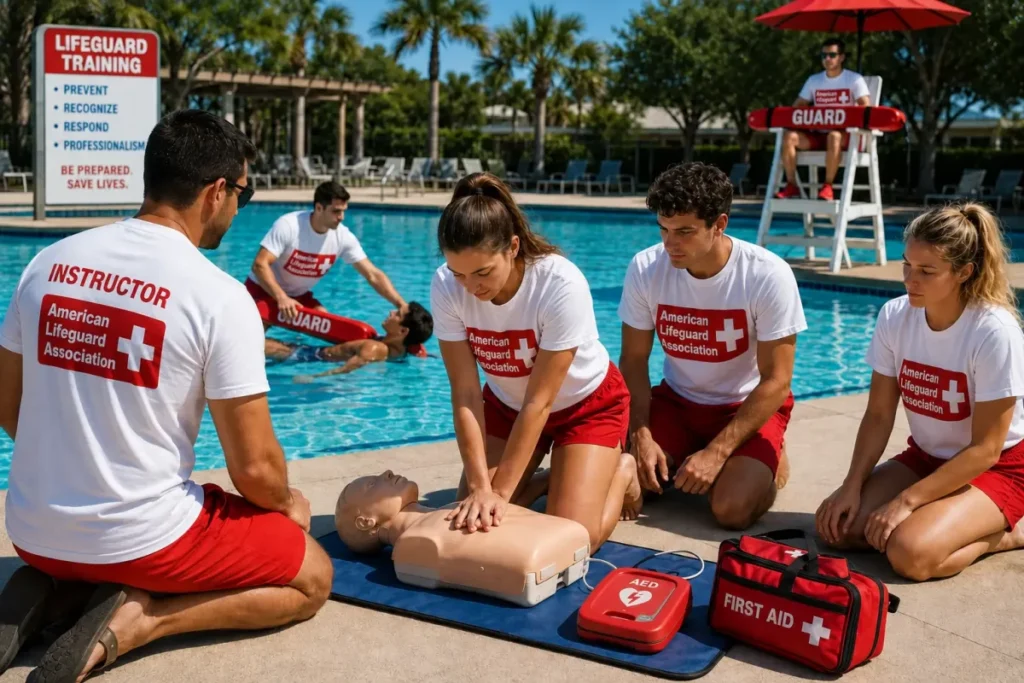
The American Lifeguard Association offers lifeguard training through a video instructor-led blended learning format. This format allows students to complete structured academic instruction while preparing for the practical responsibilities of lifeguarding.
This approach is especially helpful for students, employers, parks and recreation departments, aquatic facilities, camps, schools, resorts, and organizations that need flexible access to lifeguard training during busy hiring seasons.
ALA’s blended format is designed to support learning, preparation, and accessibility. Students can begin the academic portion of their training in a structured way while moving toward certification and employer-based readiness.
It is important to describe this correctly. ALA’s training is video instructor-led blended learning, not simply “online-only.” Practical competency is addressed within the aquatics environment through employer-based pre-service evaluations and ongoing in-service procedures established to meet CDC Model Aquatic Health Code requirements. These are CDC MAHC requirements and national standards set by the CDC, not requirements created by ALA.
The CDC Model Aquatic Health Code defines a “Qualified Lifeguard” as an individual who has completed a nationally recognized lifeguard training course, holds a current certificate, has met pre-service requirements, and participates in continuing in-service training at the aquatic facility. (CDC)
That means lifeguard training is only one part of readiness. The aquatic facility must also confirm that the lifeguard can perform required responsibilities in the specific environment where they will work.
After completing lifeguard training, employers and aquatic facilities should confirm practical readiness before assigning a lifeguard to duty. Every pool, waterpark, waterfront, resort, school, or aquatic center has its own layout, hazards, equipment, communication system, emergency action plan, and surveillance zones.
The CDC Model Aquatic Health Code addresses pre-service training and continuing in-service training as part of aquatic facility operations. It also describes a qualified lifeguard as someone who has completed training, holds a current certificate, has met pre-service requirements, and participates in continuing in-service training. (CDC)
Employer-based pre-service evaluation may include:
Facility orientation.
Emergency action plan review.
Rescue equipment location.
Zone coverage and scanning responsibilities.
CPR/AED and First Aid readiness.
Water rescue skill demonstration.
Communication procedures.
Incident documentation.
Team response drills.
Facility-specific rules and patron management.
This process helps ensure that lifeguards are prepared not only in theory, but in the actual aquatic environment where they will work.
First-time lifeguards need training that builds confidence from the beginning. Many students who enroll in lifeguard training are preparing for their first job. They may be strong swimmers, but they still need to learn how lifeguarding works as a professional responsibility.
Lifeguard training helps first-time students understand how to think like a lifeguard. That includes scanning the water, staying alert, identifying risk, enforcing rules, using rescue equipment, responding to emergencies, and communicating with guests and other staff.
Lifeguarding can be an excellent first job because it teaches responsibility, leadership, maturity, and emergency readiness. A trained lifeguard learns to stay calm, make decisions under pressure, and understand the importance of public safety.
For students looking for summer employment, lifeguard training can open the door to work at pools, recreation centers, waterparks, country clubs, camps, schools, hotels, and resorts.
Employers need lifeguards who are prepared, responsible, and ready to work in real aquatic settings. Group lifeguard training can help facilities prepare staff before the season begins or support new hires during periods of high demand.
The American Lifeguard Association can support training for individuals and groups, helping employers move staff through the academic training process while maintaining the employer’s role in facility-specific evaluation and in-service practice.
Aquatic employers should treat lifeguard training as part of a larger safety system. Certification is important, but employers should also conduct orientation, pre-service skills evaluation, emergency action plan practice, and ongoing in-service training.
This approach supports safer operations and helps ensure lifeguards are familiar with the facility where they will actually work.
Lifeguard training requirements can vary depending on the course, employer, state, local authority, facility type, and aquatic environment. Students should always confirm requirements before beginning work.
In general, lifeguard candidates should be comfortable in the water, physically capable of performing rescues, able to follow instructions, and prepared to complete CPR/AED and First Aid training.
Federal youth-employment guidance also addresses age requirements for lifeguard employment. The U.S. Department of Labor explains that 15-year-olds, but not youth under age 15, may be employed as lifeguards at traditional swimming pools and most water amusement park facilities when the required conditions are met. Natural environment facilities such as rivers, streams, lakes, reservoirs, wharfs, piers, canals, and oceanside beaches require lifeguards to be at least 16 years old for employment. (DOL)
Students should also understand that employers may have additional requirements, including swim tests, physical skills checks, background screening, orientation, uniform standards, emergency action plan training, and local health department rules.
The time required for lifeguard training can vary depending on the program, training format, student preparation, and employer requirements. ALA’s public materials state that its lifeguard classes typically require 27.5 hours of instruction, including in-water and out-of-water training. (American Lifeguard Association)
Students should plan enough time to complete the academic training, review course materials, prepare for knowledge testing, practice water skills, and complete any employer-based pre-service evaluation required by the aquatic facility.
For many students, the most important question is not simply how fast training can be completed. The better question is whether the training prepares them to perform responsibly when lives may depend on their actions.
A complete lifeguard training program should include CPR/AED and First Aid because lifeguards are often the first trained responders at an aquatic emergency. A lifeguard may need to begin care before EMS arrives, especially when a drowning, breathing emergency, injury, or sudden illness occurs.
CPR/AED training helps lifeguards respond to cardiac and breathing emergencies. First Aid training helps lifeguards respond to injuries and illnesses. Together, these skills are essential for aquatic safety.
The CDC Model Aquatic Health Code includes CPR/AED, First Aid, emergency response, hazard identification, injury prevention, and legal issues among important lifeguard training elements. (CDC)
For this reason, lifeguard training should never be treated as only a swimming course. It is emergency response training for the aquatic environment.
Lifeguard training teaches physical skills, but it also builds judgment and professionalism. A lifeguard must know when to intervene, how to speak to guests, how to enforce rules, how to communicate with other staff, and how to stay alert during long periods of surveillance.
Professional lifeguard training helps develop:
Confidence.
Leadership.
Communication.
Responsibility.
Focus.
Teamwork.
Emergency judgment.
Public safety awareness.
A lifeguard’s mindset matters. The best lifeguards understand that prevention is part of the job every minute they are on duty.
When choosing a lifeguard training program, students and employers should look for training that covers the full range of lifeguard responsibilities. The program should prepare students to recognize danger, perform rescues, provide emergency care, and understand professional expectations.
Before enrolling, consider these questions:
Does the training include lifeguarding, CPR/AED, and First Aid?
Does the program address surveillance and prevention?
Does it explain emergency action plans?
Does it prepare students for employer-based skills evaluation?
Does the provider support individual and group training?
Can credentials be verified?
Does the training format fit the student’s schedule?
Does the program support real-world aquatic readiness?
The right lifeguard training program should help students move from interest to preparation to employment readiness.
The American Lifeguard Association has over 35 years of experience in lifeguard training and aquatic safety education. Its stated mission is to improve the quality and accessibility of health and safety programs to the public. (American Lifeguard Association)
ALA’s lifeguard training is designed for students and employers who need a practical path toward certification and readiness. The program supports lifeguarding, CPR/AED, First Aid, rescue preparation, injury prevention, and aquatic safety education.
ALA also uses Universal Lifeguard Certification to support credential verification and online access to professional records. Public ALA training materials state that ULC allows lifeguards to manage professional credentials online and supports certification validation. (American Lifeguard Association)
Many students search for “lifeguard training near me” because they need certification for a job, summer employment, school program, camp position, or aquatic facility. ALA’s flexible training model helps students begin the process without waiting for a traditional class schedule in every location.
For employers, flexible lifeguard training can be especially helpful during the busy season, when staffing needs can change quickly and qualified lifeguards are in demand.
When searching for lifeguard training near you, remember that the nearest option is not always the best option. Look for a training provider that covers rescue skills, CPR/AED, First Aid, surveillance, emergency response, and professional responsibility.
You should also ask your employer what facility-specific pre-service evaluation and in-service training will be required before you begin working.
No. ALA’s program should be described as video instructor-led blended learning. Practical competency is addressed within the aquatics environment through employer-based pre-service evaluations and ongoing in-service procedures established to meet CDC Model Aquatic Health Code requirements.
Join thousands trained by the American Lifeguard Association. Nationally recognized certification, backed by 30+ years of experience.