American Lifeguard Classes Comprehensive Training and Certification Program
ON THIS PAGE
OVERVIEW Lifeguard Certification
Lifeguard certification is an important step for anyone who wants to work as a lifeguard at a swimming pool, waterpark, camp, school, resort, fitness center, community aquatic facility, or other supervised aquatic environment. A lifeguard certification shows that a participant has completed a recognized training program covering the knowledge and skills needed to help prevent, recognize, and respond to aquatic emergencies.
The American Lifeguard Association® provides lifeguard certification programs designed to support aquatic safety, drowning prevention, emergency response, CPR/AED, First Aid, and professional lifeguard readiness. Lifeguard certification is not simply a document. It represents preparation for a serious public safety role.
The need for trained and certified lifeguards remains urgent. The CDC reports that every year in the United States there are more than 4,000 unintentional drowning deaths, and CDC data also identifies drowning as the number one cause of death for children ages 1–4 in the United States.
That is why lifeguard certification matters. A properly trained lifeguard helps prevent emergencies before they happen, recognizes swimmers in distress, performs rescues, provides CPR/AED and First Aid, activates emergency action plans, and supports a safer aquatic environment.
What Is Lifeguard Certification?
Lifeguard certification is a credential issued after a participant successfully completes the required lifeguard training and certification process. It is used by students, employees, aquatic facilities, parks and recreation departments, schools, camps, resorts, and employers to document that a person has completed lifeguard training.
A complete lifeguard certification program should prepare candidates in several key areas:
Water safety and injury prevention.
Water surveillance and victim recognition.
Rescue skills and use of rescue equipment.
CPR/AED and First Aid.
Emergency action plans.
Professional lifeguard responsibilities.
Legal and ethical responsibilities.
Facility readiness and continued skill practice.
The CDC Model Aquatic Health Code identifies lifeguard training course content as including hazard identification and injury prevention, emergencies, CPR, AED use, bag-valve-mask use, First Aid, and legal issues.
This means lifeguard certification should be viewed as emergency response preparation for the aquatic environment. A certified lifeguard is expected to understand prevention, rescue, emergency care, communication, teamwork, and professional conduct.
Why Online Lifeguard Training Matters
Lifeguard training matters because drowning remains a serious public safety issue. The CDC reports that more children ages 1–4 die from drowning than any other cause of death, that drowning is the second-leading cause of unintentional injury death for children ages 5–14, and that the United States has more than 4,000 unintentional drowning deaths each year.
Those facts show why access to lifeguard training is so important. Communities need trained lifeguards. Employers need a practical way to prepare staff. Students need a flexible way to begin certification. Families need safer aquatic environments.
Online lifeguard training helps address one of the biggest challenges in aquatic safety: access. Traditional in-person classes may not always be available when a student or employer needs them. Seasonal hiring can happen quickly. Pools, waterparks, camps, and resorts may need lifeguards before a local class is scheduled. A video instructor-led blended learning model helps reduce unnecessary delays while still preserving the essential role of practical skill evaluation.
A lifeguard’s job is too important to leave preparation to chance. Flexible training access helps more candidates begin the process and helps employers support safer staffing.
320K
Global drowning deaths each year (WHО)
#1
Cause of injury death, ages 1-4 in the U.S.
30+
Years of ALA lifeguard training
Why Lifeguard Certification Is Important
Lifeguard certification is important because lifeguards are trusted with public safety. When a guest enters a pool, waterpark, waterfront, resort pool, or supervised swimming area, they depend on trained lifeguards to help maintain a safer environment.
The U.S. Department of Labor describes a core and defining duty of a lifeguard as rescuing swimmers in danger of drowning, often by entering the water and physically bringing the swimmer to safety.
That responsibility requires more than strong swimming ability. A lifeguard must know how to prevent emergencies, recognize distress, enter the water safely, use rescue equipment, remove a victim, provide emergency care, and work with other staff.
Lifeguard certification helps document that a candidate has completed formal training in these responsibilities. Employers can then build on that certification with facility-specific orientation, practical competency evaluation, emergency action plan practice, and ongoing in-service training.
Certification is the foundation. Professional readiness continues at the facility.
Certification American Lifeguard Association® Certification
The American Lifeguard Association® offers lifeguard certification programs designed to help students and employers meet training needs in a practical and accessible way. ALA’s website states that the association has been offering lifeguard courses for over 35 years and provides training in lifeguarding, CPR/AED, First Aid, rescue skills, and injury prevention.
ALA’s lifeguard certification pathway is designed for individuals who want to become lifeguards, employers that need to train staff, and organizations that need flexible certification options during busy hiring periods.
The American Lifeguard Association® supports:
Lifeguard certification.
CPR/AED training.
First Aid training.
Shallow water lifeguard training.
Group training options.
Employer-supported training.
Credential verification through Universal Lifeguard Certification.
ALA’s public materials also state that the association uses Universal Lifeguard Certification to verify the credentials of American Lifeguard™ lifeguards and allow professional records to be viewed, printed, and managed online.
Recognition Recognition of ALA Lifeguard Certification
This is an important point for employers, students, and aquatic facilities because federal youth-employment guidance specifically addresses lifeguard certification for certain lifeguard duties.
The best practice is simple: obtain certification, verify employer requirements, complete facility-specific pre-service evaluation, and participate in ongoing in-service training.
Lifeguard Certification and Employer Acceptance
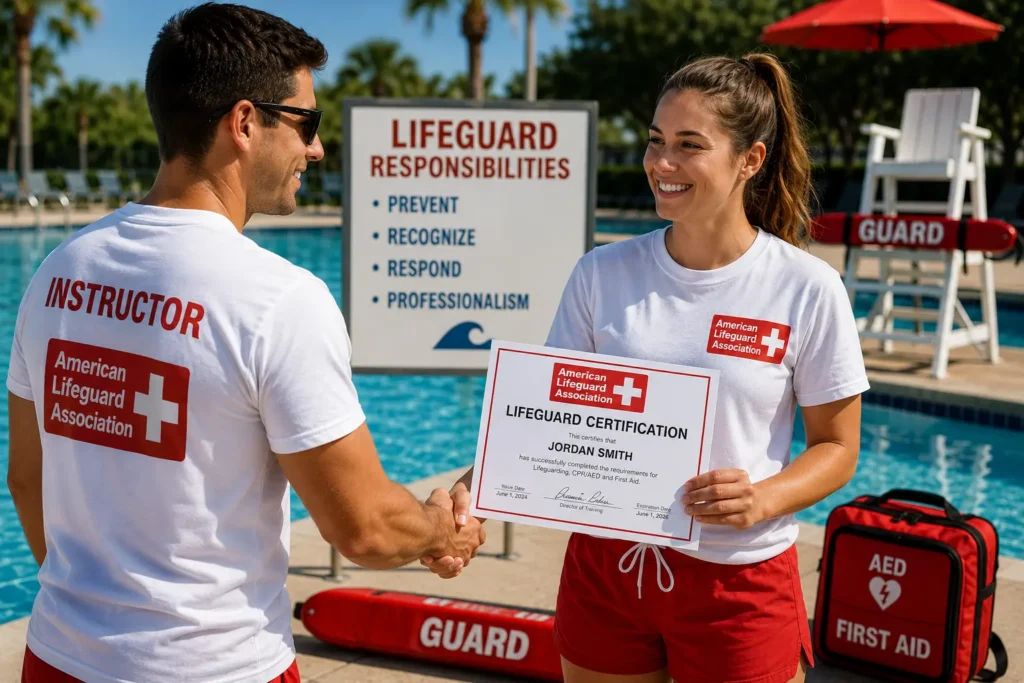
Many students search for lifeguard certification because they need a credential for employment. Employers often require lifeguard certification before allowing a person to work on duty. Certification helps employers confirm that a candidate has completed a formal training program covering lifeguarding, CPR/AED, First Aid, and emergency response.
However, responsible employers should not rely only on a certificate. A certificate documents training completion, but the employer still needs to confirm that the lifeguard can perform the required duties in the actual aquatic environment where they will work.
Every facility is different. A community pool, resort pool, wave pool, shallow water attraction, school pool, summer camp, and beach environment may each have different risks, layouts, equipment, communication systems, emergency action plans, and surveillance zones.
That is why certification and employer-based evaluation work together. Lifeguard certification provides the training foundation. The employer confirms facility-specific readiness.
Video Instructor-Led Video Instructor-Led Blended Lifeguard Certification
The American Lifeguard Association® offers lifeguard certification through a video instructor-led blended learning format. This format allows students to complete structured academic instruction while preparing for the practical responsibilities required in aquatic environments.
This approach is especially useful for students, employers, parks and recreation departments, schools, camps, resorts, hotels, fitness centers, and aquatic facilities that need flexible training options.
ALA’s certification should be described accurately as video instructor-led blended learning, not simply “online-only.” Practical competency is addressed within the aquatics environment through employer-based pre-service evaluations and ongoing in-service procedures established to meet CDC Model Aquatic Health Code requirements. These are CDC MAHC requirements and national standards set by the CDC, not requirements created by American Lifeguard Association®.
The CDC Model Aquatic Health Code defines a “Qualified Lifeguard” as an individual who has completed a nationally recognized lifeguard training course, holds a current certificate, has met pre-service requirements, and is participating in continuing in-service training requirements of the aquatic facility.
That definition is useful because it clearly shows that lifeguard certification, pre-service requirements, and continuing in-service training are all part of lifeguard readiness.
Practical Competency After Certification
After completing lifeguard certification, practical competency must be confirmed in the aquatic environment. This is especially important because lifeguards must be able to perform rescue and emergency response duties at the specific facility where they will work.
The CDC Model Aquatic Health Code states that pre-service requirements include facility-specific policy and procedure training, demonstration of safety team skills specific to the aquatic facility before assuming on-duty lifeguard responsibilities, and documentation of training. It also provides that aquatic facility staff participate in periodic in-service training to maintain skills.
Employer-based pre-service evaluation may include:
Reviewing the facility’s emergency action plan.
Identifying surveillance zones.
Practicing rescue response routes.
Locating rescue tubes, backboards, AEDs, First Aid kits, and emergency oxygen.
Demonstrating CPR/AED and First Aid readiness.
Demonstrating water rescue skills.
Understanding patron rules and enforcement expectations.
Practicing team communication.
Documenting facility-specific training.
This process helps ensure that lifeguards are not only certified, but also ready for the actual environment where they will serve.
Include What Does Lifeguard Certification Include?
Lifeguard certification typically includes several core training areas. A strong certification program should prepare students for the realities of lifeguarding, not just the completion of a course.
Water Rescue Skills
Lifeguards must know how to respond to swimmers in distress, use rescue equipment, protect themselves during a rescue, support the victim, remove the victim from the water, and begin care when needed.
Water rescue skills may include entries, approaches, assists, rescue tube use, active victim rescues, passive victim rescues, submerged victim recovery, and victim removals.
CPR/AED
CPR/AED training is essential because lifeguards may need to respond to cardiac or breathing emergencies before EMS arrives. Lifeguards must understand how to begin CPR, use an automated external defibrillator, and continue care until additional help arrives.
First Aid
Lifeguards often respond to injuries and illnesses around aquatic facilities. First Aid training helps lifeguards provide care for cuts, falls, heat illness, head injuries, breathing concerns, allergic reactions, and other emergencies.
Surveillance and Prevention
The best lifeguard is not only reactive. Lifeguards must scan the water, recognize unsafe behavior, enforce facility rules, identify hazards, and intervene before an emergency develops.
Emergency Action Plans
Lifeguards must understand how to activate and follow emergency action plans. These plans help coordinate rescue, care, communication, crowd control, EMS contact, and incident documentation.
Professional Responsibility
Lifeguards must remain alert, focused, respectful, physically prepared, and ready to act. Certification helps introduce the professional expectations that come with the role.
How to Get How to Get Lifeguard Certified
The process for becoming lifeguard certified generally includes training, testing, certification issuance, employer review, and facility-specific preparation.
A typical pathway includes:
Choose the correct lifeguard certification program.
Select the certification that matches your intended work setting, such as pool lifeguarding, shallow water lifeguarding, or other aquatic environments.
Complete the required coursework.
Through ALA’s video instructor-led blended learning format, students complete structured academic instruction covering lifeguarding, CPR/AED, First Aid, prevention, and emergency response.
Complete required testing and certification steps.
Participants must successfully complete the required program components before certification is issued.
Complete employer-based pre-service evaluation.
Practical competency is addressed in the aquatic environment through employer-based pre-service evaluation and documented facility-specific training.
Participate in ongoing in-service training.
Lifeguard skills must be maintained through continued practice, drills, and in-service procedures established to meet CDC Model Aquatic Health Code requirements.
This pathway helps support both certification and real-world readiness.
Requirements Lifeguard Certification Requirements
ALA’s public FAQ states that participants must be at least 15 years old by the end of the course and complete the following swim prerequisite:
- Jump into the water, fully submerge, resurface, and swim 150 yards using the front crawl, breaststroke, or a combination of both.
- Maintain position at the surface for two minutes by treading water using only the legs.
- Swim 50 yards using the front crawl, breaststroke, or a combination of both.
The complete sequence must be performed without stopping to rest. Participants must also complete a timed event that includes retrieving a 10-pound object from 7 feet of water.
In addition, federal youth-employment guidance explains that 15-year-olds, but not 14-year-olds, may be employed to perform lifeguard duties at traditional swimming pools and water amusement parks when properly trained and certified by the American Red Cross or a similar certifying organization in aquatics and water safety.
Requirements may be different for deep-water, shallow-water, waterpark, waterfront, beach, or open-water environments. Employers may also require additional swim tests, skills evaluations, background checks, orientation, or local compliance steps.
How Long Is Lifeguard Certification Valid?
Certification validity depends on the certifying program and credential type. ALA’s public FAQ states that participants who successfully complete its lifeguard classes receive certifications in Lifeguarding, CPR/AED, and First Aid that are valid for two years.
Even when a certification is valid for two years, lifeguards should continue practicing their skills throughout the certification period. CPR, AED use, water rescue, surveillance, and emergency response skills can decline without practice.
That is why employers should provide ongoing in-service training, drills, and skills checks during the course of employment.
Near Me Online Lifeguard Training Near Me
Many students search for “lifeguard certification near me” because they need certification for a job, school program, summer camp, pool, waterpark, or recreation department. ALA’s flexible certification pathway helps students begin training without waiting for a traditional class schedule in every local area.
When choosing lifeguard certification near you, consider:
Does the certification include lifeguarding, CPR/AED, and First Aid?
Does the program explain prevention and emergency response?
Does the certification support employer-based pre-service evaluation?
Can credentials be verified?
Does the training format work with your schedule?
Will your employer or local authority accept the certification?
Is the training appropriate for the aquatic environment where you want to work?
The right certification should help prepare you for employment while supporting real aquatic safety responsibilities.
For Jobs Lifeguard Certification for Jobs
Lifeguard certification can help students qualify for employment at many types of aquatic facilities, including:
Community pools.
Apartment and hotel pools.
Waterparks.
Summer camps.
Schools and universities.
Fitness centers.
Country clubs.
Municipal recreation departments.
Resorts.
Private aquatic facilities.
Public swimming pools.
Lifeguarding is often an excellent job for students and young adults because it teaches responsibility, professionalism, communication, leadership, and emergency readiness. It can also be a valuable first step toward careers in recreation, aquatics management, emergency services, public safety, education, healthcare, and coaching.
Employers should verify credentials, confirm skills, review facility procedures, and document pre-service and in-service training.
Lifeguard Certification vs. Lifeguard Training
Lifeguard training and lifeguard certification are closely related, but they are not the same.
Lifeguard training is the learning process. It includes the instruction, study, practice, testing, and preparation needed to understand lifeguarding responsibilities.
Lifeguard certification is the credential issued after the participant successfully completes the required training and certification steps.
In simple terms, training prepares the student. Certification documents completion.
After certification, the employer or aquatic facility should still confirm practical competency in the actual aquatic environment where the lifeguard will work.
Verifying Lifeguard Certification
Credential verification is important for both lifeguards and employers. Employers need confidence that a certification is current, accurate, and connected to the person presenting it. Lifeguards need a convenient way to manage and renew their credentials.
The American Lifeguard Association® states that it uses Universal Lifeguard Certification to verify the credentials of ALA lifeguards and that ULC allows lifeguards to manage professional credentials online, including viewing, printing, and managing professional records for renewal.
Credential verification helps support:
Employer review.
Hiring decisions.
Renewal reminders.
Recordkeeping.
Professional accountability.
Reduced confusion over expired or missing certificates.
A certification is most useful when it can be clearly verified.
Renewing Lifeguard Certification
Lifeguards should renew their certification before it expires. Renewal helps ensure that lifeguards remain current in CPR/AED, First Aid, rescue skills, water safety principles, and emergency response procedures.
Lifeguard recertification is especially important because lifesaving skills must be maintained. A lifeguard who has not practiced rescues, CPR, AED use, or emergency action plan procedures may lose confidence and readiness over time.
Students who already hold certification should review renewal options before expiration to avoid gaps in eligibility for employment.
Why Choose Us? Why Choose the American Lifeguard Association®?
The American Lifeguard Association® provides a practical path for students and employers who need lifeguard certification. ALA’s certification programs support lifeguarding, CPR/AED, First Aid, rescue skills, injury prevention, and aquatic safety education.
Students and employers choose American Lifeguard™ because the association offers:
Video instructor-led blended learning.
Lifeguard certification.
CPR/AED and First Aid certification.
Flexible training access.
Individual and group training options.
Credential verification support.
Employer-supported practical competency pathway.
A focus on drowning prevention and emergency response.
Federal guidance recognizing American Lifeguard Association® lifeguard certification programs as similar to those offered by the American Red Cross for purposes of 29 CFR § 570.34(l).
The purpose of certification is not only to receive a credential. The purpose is to prepare lifeguards to help prevent emergencies, respond effectively, and support safer aquatic environments.
FAQs Frequently Asked Questions About Lifeguard Certification
What is lifeguard certification?
How do I become a certified lifeguard?
Does lifeguard certification include CPR/AED and First Aid?
Is ALA lifeguard certification recognized?
The U.S. Department of Labor’s Field Operations Handbook states that the Wage and Hour Division has determined that the American Lifeguard Association® offers lifeguard certification programs similar to those offered by the American Red Cross and that they satisfy the requirements of 29 CFR § 570.34(l). Students should still confirm acceptance with their employer, local authority, or facility. (DOL)
Is ALA lifeguard certification online-only?
How long is ALA lifeguard certification valid?
What age do you need to be for lifeguard certification?
Age requirements may vary by course, employer, and location. ALA’s public FAQ states that participants must be at least 15 years old by the end of the course. Federal youth-employment guidance also addresses properly trained and certified 15-year-old lifeguards at traditional swimming pools and water amusement parks.
What happens after I receive lifeguard certification?
Can employers verify ALA lifeguard certification?
Do I need lifeguard recertification?
Yes, lifeguards should renew their certification before expiration. Recertification helps maintain readiness in rescue skills, CPR/AED, First Aid, emergency response, and professional lifeguard responsibilities.
Ready to become a certified lifeguard?
Join thousands trained by the American Lifeguard Association®. Nationally recognized certification, backed by 30+ years of experience.
Visit our Affiliates